Thursday, 27 September 2012

STRATEGIC IMBALANCE

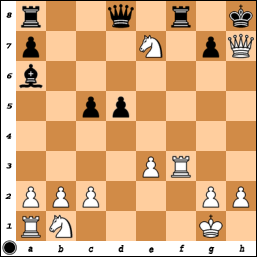
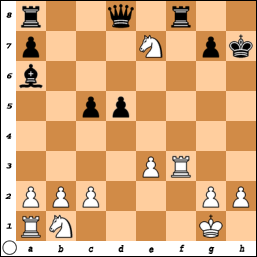
In this game due to my blunders I am a Rook up but my opponent has two extra pieces

As we go into the late middle game the question becomes how to win

Sunday, 10 June 2012

COMBATING THE SICILIAN

Sometimes a lot of people like to avoid the sicillian as white ,as I did for a long time but black doesn't always play so well with it and you don't always have to learn book loads of theory to be able to give it a good go....


In this opening black has responded with a common sicilian and played e5 to drive the white knight from its central posting,a common way to complicate play is as follows.
White can play the seemingly odd looking move b5 it looks as though the white knight can be easily kicked from there however black has to be careful.If after d6 to prevent (check on d6 bishop takes d6 creating a massive hole on d6 which would be problematic for black.)White can respond

White can bring his other knight to d5 tempting black to take his hanging pawn if black does so Qf3 wins the game,The knight it self is hanging and of course there is the threat of check on the c7 square,which is attacked by both white knights.


.
This position can occur if instead of coming down to take the loose pawn the black knight takes the white knight on d5 and then after pawn takes the black knight on c6 moves to e7 .
White then reinforces his knight on b5 by c4 and any attempt to kick the knight staioned on b5 with a6 is met by Qa4.
If however black instead atempting to retreat his own knight on c6 simply attacks whites b5 knight we just take his knight on c6 ,then after he responds by taking ours we can just take again on b7 ,blacks bishop will then recapture on b7 and then we play Bxb5* and end up with the position below.

ROOK PLAY!

...Nice little Rook combo at the end gives me the win .

Wednesday, 25 April 2012

puzzle #2

In the last puzzle the corect move would've been the sharp Qf3 forcing the a almost inevitable loss of the white rook.


In the next puzzle there is a underlying theme that of pins and double attack or threats as well as the problematic back line threats.
I plan in later posts to display quite a few examples of this tactical motif as repetition makes for good learning as I am finding out,not a easy thing to do in practice however.

In the puzzle above white to play demonstrates a motif in a very basic form I will try to expand and add more complex variations of it later white wins from this position.

Sunday, 22 April 2012

Puzzle #1

A puzzle that I failed to spot in one of my games started of from this position where I spotted a potential double attack.The knight was previously on g4 and has just taken a pawn on f2 with a double attack on the white rook which was on d1.I was playing black and,but what is the best continuation?

Friday, 10 February 2012

THE ULVESTAD VARIATION RESPONSE TO EARLY NG5

It always surprises me how little used this opening is in the two knights early knight to g5 opening (also wrongly refered to as the the fried liver attack by a lot of people.....

the classic beginning of the early knight g5 attack


Looks familiar doesn't it some people playing black even play h6 on their third move to prevent white from playing this opening which is absurd,when we have this wonderful opening at our disposal.

the game continues


white naturally takes


and now the b5 pawn move this is the position that is known as the ulvestad it looks a very odd move which is why it can trick a lot of unsuspecting people


if white takes the pawn as he often does then we capture the center pawn with our queen threatening the bishop and pawn on g2 it is here that white will often swap off pieces taking the white knight and then castling thinking that all is well being a pawn up and already castled


after white castles we then play bishop to b7 which threatens mate in one.Our other bishop can come across to be aimed at the white kingside later on white will have great difficulty in negotiating the middle game and we have excellent chances.


NOTES

It pays to go over some important themes

the importance of the dark squared bishop in creating a attacking diagonal against the white king if at all possible,such as in this position

Tuesday, 7 February 2012

FINISHING OFF THE OPPONENT AFTER A MISTAKE

The mistakes in question include the vunerability of the f7 square which is a key consideration in these kind of openings also the exchange of bishops was a mistake especially considering the careful use of my own bishop....Poor re routing of knights can be added to the list .

Its also important to see how the light sqared bishop can be used to devastating effect in these Ruy Lopez opennings and not just exchanged for a knight.


Saturday, 4 February 2012

PLANNING HOW TO ATTACK DOWN A FILE WHEN CENTRE IS LOCKED

Here's a win that shows some of my thought processes and how I put together some of the things I have recently learned as in looking to understand more of the strategy of the game.
Also there's a bit at the end where tactics come into play in a decisive manner.....
In this game I took advantage of space, movability and also had a well thought out defensive plan that I was able to change to attack very quickly.

More then anything this is a game where I saw how to attack down a flank if the centre is locked and how to plan for this in advance


Wednesday, 18 January 2012

ANALYSING THE REASONS FOR DEFEAT

MY KINGDOM FOR A PAWN

I recently became aware of the fact that many of my defeats seem to result from similar oversights or mistakes and these then form patterns that are repeated..
It also seems apparently that many of my defeats result from either outright blunders,or miscalculations in tactical positions when I try something daring although some of my miscalculations could also be put interpreted as blunders,just not of the absolute howler variety.

I have gone through 20 of my most recent defeats to gain a statistical overview of my defeats as it always helps to see the facts in black and white ..

and I learnt something I didn't suspect that many of my defeats result from the lose of a single pawn..

THE LOSE OF A PAWN CAN SEEM TO BE INSIGNIFICANT IN THE EARLY STAGES.. BUT CAN LEAD TO STRATEGIC DIFFICULTIES AND WHICH ALSO PRESENT A LONG TERM DISADVANTAGE IN THE ENDGAME.

This may at first seem obvious but I think one of the things that would help my planning in the early stages of a game and on into the middlegame is to include the idea of the preservation of pawns as a theme .

TOO OFTEN PLAYERS OF MY RATING CONCENTRATE ON THE PRESERVATION OF MAJOR AND MINOR PIECES AND THE ATTACKS THAT CAN STEM FROM THEM.

Also passivity of pawn structure as from the riddiculos example in game 3 can be a trouble habit to get out of


GAME 1

Bad tactical play late middlegame ..

I was white and I eventually lost the passed pawn and the game.


GAME 2

This in which I play black one has all the hallmarks of a strategic defeat relatively shattered pawn structure and a disjointed position .White manages to increases his small advantages and eventually win the game..


GAME 3

I was white and my passive pawns cost me the game even though I was a pawn up.I was actually a piece up as well until a couple of moves prior to this as well.

Tuesday, 6 December 2011

Tactics and Strategy

A game I won where I combined tactics and strategy for a win I always prefer open games especially in e4 openings and I am careful not to make mistakes but am always on the lookout for a knockout blow in the form of a winning tactic....
Here I saw him preparing something so I thought I would beat him to it with something of my own..

Monday, 21 November 2011

A two way attack!

One of the most difficult things in a chess game is to calculate both a attack by your own pieces and a defence against a opponents attack at the same time.
Its double the normal calculation then I am used to doing normally I am either attacking or defending but here both combined,so it takes careful study to correctly figure out the move.

It also doesn't help that they're no immediate tactics but rather ones that will show fruition in four or five moves,which adds to the complications.


Sunday, 30 October 2011

Calculation

Although I managed to win I could've won a lot easier and the amount of tactical combinations which I failed to see in this game could fill a tactics puzzle book.

Just a little calculation could've made the game so much easier,thinking about it I find these can of tactics the hardest the get right the sort where you are forced to allow your opponent a tempo during the attack.

You then have to calculate not just the effectiveness of your own combination his defence to it,
but also wheather or not he can start a attack of his own with the tempo you have given him!

So its three factors which you have to consider instead of the normal two!!


Here queen to d4 presents all sorts of threats and is by for the best move and really gives life to the possibility of a discovered attack against the king 17. Qd4 b6 18. Bxb6 Qc6 19. Bc5 Bd7 20. Bb5 Qd5 21. Qxd5 exd5 22. Bxd7 Ke7


In this position for example a simple winning move would have been Rf2...trapping the queen ..


In this position bishop d7 with the following 27. Bd7 f5 28. Bxe6+ Kxe6 29. Qb6+ Kf7 30. Qf6+ Ke8 31. Qxh8 Qd7 32. Qxh7 Qxa4 33. Bxe7 Qd4+ 34. Rf2 Bxe7 35.

I also missed mating combinations on moves 32 33 34 and 36 although in my defence they were complicated and long combinations...

Wednesday, 26 October 2011

What a 1500-1800 player should know.

As a player who is within this rating range I thought I would give a quick overview of my playing style and what a middle rated player should be able to do and their general style of play.
In the opening I will more often then not, at a minimum try to get out of the opening with a fairly equal position I am pretty confident I can get a fairly equal position even against a strong chess engine like Rykba.

A 1500-1800 player should know a few opening very well for example I particulary like playing the Ruy Lopez,The Italian game,The Fork Trick Attack and the Ulvestad Variation of the two Knights Defence.

He should also know how to cease upon any mistakes generally when a opponent neglects making central moves in the beginning and then fails to castle early,and of course the typical beginners mistake of bringing the queen out on the third move.


So in the game above I play against Rykba and can get to move 12 and still have a playable position and could probably carried on for a few more moves the score in the game above is -0.33 after 12 moves.
However this is the opening I am most familar with,the point is that if I could do it against Rykba I can do it against most online opponent,needless to say Rykba has a incredibly high ELO rating.

Once a player stops being crushed in the openning it gives him a increased amount of confidence which can really take his game forward then it all becomes about the tactics of the middle and endgames.

IN THE SICILIAN


The position above is one I managed to attain in the Sicilian opening which is a opening I rarely play,the whole point is that if you can attain playable positions against Rykba 2.2 you can almost certainly attain them against human opponents.

Sunday, 16 October 2011

Two Quick Wins!!

In the first game I played white and in the second black..I always love winning minitures and studying them can be highly instuctive..


It always feels rewarding after much concentration to see a move that has such power,a couple of days before I was viewing the famous legal trap opening whose theme has a similar pattern to the winning combination I played in this game and I think I'll make a point of running a eye over the creative offerings of the masters more often.

Wednesday, 12 October 2011

Anastasia's Mate

Here's a little tactic I played which proved to be winning just goes to show you never know when these tactical sequences you memorize will come in handy and that you should always play with some kind of plan or scheme in mind.
A bad plan is better then no plan as they say not that it was a bad plan but just a simple one which proved effective.


1.STARTING POSITION

3.SEE IF YOU CAN SPOT THE MOVE
I GIVE A CHECK


4.CHECKING WITH THE KNIGHT

5.INTO A CORNER
HE COULD TAKE WITH HIS QUEEN BUT THIS WOULD END UP LOSING THE QUEEN


6.TIME FOR SACRIFICE

7.ONLY MOVE

CHECKMATE

Saturday, 8 October 2011

PAWNS AND KING ENDGAME LESSON

In this position my opponent obliviously played a blunder and after the exchange of Rooks I am in a winning position but there was still a moment of crisis when I could have still lost so you've go t to be careful ..I am playing the black pieces...

Friday, 7 October 2011

IF THERES ONE ENDGAME YOU LEARN MAKE IT THIS ONE!!

THE LUCENA POSITION


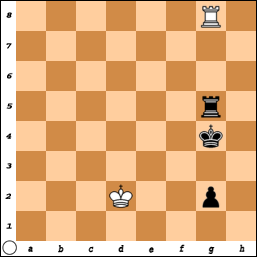
The whole point about this position is that you get to learn how to win a position which is king and rook v king and rook plus one pawn ,the deal is to be able to convert your extra into a queen or force your opponent to trade his rook for your passed pawn thus winning.

As you can see from the diagram the black pawn is one move away from queening so how to finish this position of important to remember this technique can be used even if the pawn is further away from the queening square.

1..FIRST FORCE THE WHITE KING AWAY FROM THE PAWN..

2..NOW BRING THE BLACK ROOK TO THE FOUTH RANK

Very important to remember to bring the rook to the fourth rank as we plan to swap rooks off and
this is a essential component of the plan


3..After the white rook plays g8 to place itself behind the black pawn you simply play kf2 ,white will check on f8 then the king goes to g4 if g8 check then the black rook comes across the block the check.


Ideally you should end up in a position like this ....were the if the rooks are exchanged the white king will not be able to stop the black pawn from becoming a queen.


Its important to remember that your opponent can not easily deviate from the standard moves and if you practice this endgame against a engine you will be surprised at how good you become at it
and how much easier it becomes to understand some of the easier principles of chess,also you will be surprised at how many people do not know how to play a endgame like this properly

Monday, 3 October 2011

Grinding out a king and pawns endgame

I was playing white in this games and I was happy with the way I played I have included annotations with this game.


IMPORTANT POINTS
Lately like a lot of us who try to improve our chess I have started to try and understand one of silmans ideas where he said when you 're looking for tactics look for double attacks
I think all tactics are essentially double attacks of one kind or another and I think I did this when I move my queen down his side of the board on move 26 and with the following move by bringing my rook down also ...perhaps I should correct myself move a double threat then a double attack but the principle still applies I think...if you make two threats at once often times only one will be able to be defended adequately